6 Tools That Will Change How You Practice Piano
By Melissa Clement on behalf of Michael Clement
Something that I hear all the time from students is this: “If I only practiced more, I would be getting better.”
I get it. We've all heard "practice makes perfect." And yes, consistent practice matters. But if you've ever sat down for a long session and walked away feeling like you spun your wheels the whole time, you already know that practice time alone isn't always the same as reaching your goals or getting you closer to the musician you want to be.
What actually makes the difference isn't how long you practice, but what you actually accomplish during your practice time—whether that’s 30 minutes or 3 hours.
The good news? Intentional practice doesn't require expensive gear or a fancy studio setup. Some of the most powerful shifts I've seen in my students (and in my own playing) have come from simple tools used with clear purpose.
Here are six of them, and how to actually use each one.
1. A Physical Timer (That's Not Your Phone)
This might be the most counterintuitive tool on the list. That’s because the way most musicians use timers is actually the problem.
Most of us use time as the goal. We sit down to practice for 30 minutes, or an hour, and we feel good if we make it to the end. But what if instead of asking “how long should I practice,” you started asking “what am I trying to solve, and how much time do I need to solve it?” That one shift changes everything about how a session feels.
The typical approach: Set a timer for 30 minutes and practice until it goes off.
On paper, that sounds reasonable, and a lot of my life I practiced this way. I found, over time though, that in practice, I ended up watching the clock and waiting for permission to stop. That meant I wasn’t actually focused on the music.
When time becomes the goal of a practice session, improvement becomes kind of accidental rather than intentional.
In a recent YouTube video, I put it this way:
"When sitting down to play, beginners often think, 'I need to practice 30 minutes a day'... and then you actually sit down and you don't know what to do. Maybe you look at your list of assignments and somehow you're both bored and overwhelmed at the same time."
The reframe: Instead of using a timer to make yourself practice longer, use it to limit how long you're allowed to spend on one specific thing.
The way I do it: before I start, I name the exact thing I'm working on—a particular four-bar phrase, a chord transition that's not landing, or a specific improvisation concept. Then I pick a short window of time (5, 10, or 25 minutes) and set the timer. When it goes off, I stop. If I solved the problem, great! I move on. If I didn't, I flag it for the next session.
The reason this works is because having a clear stopping point in front of you actually focuses your attention in a way that open-ended practice doesn't. It's a small thing, but the shift from "practice until the time is up" to "solve this one problem in the time I have" changes the whole feeling of a session.
Limiting what you play and how long you explore it forces you to get in the creative mindset.
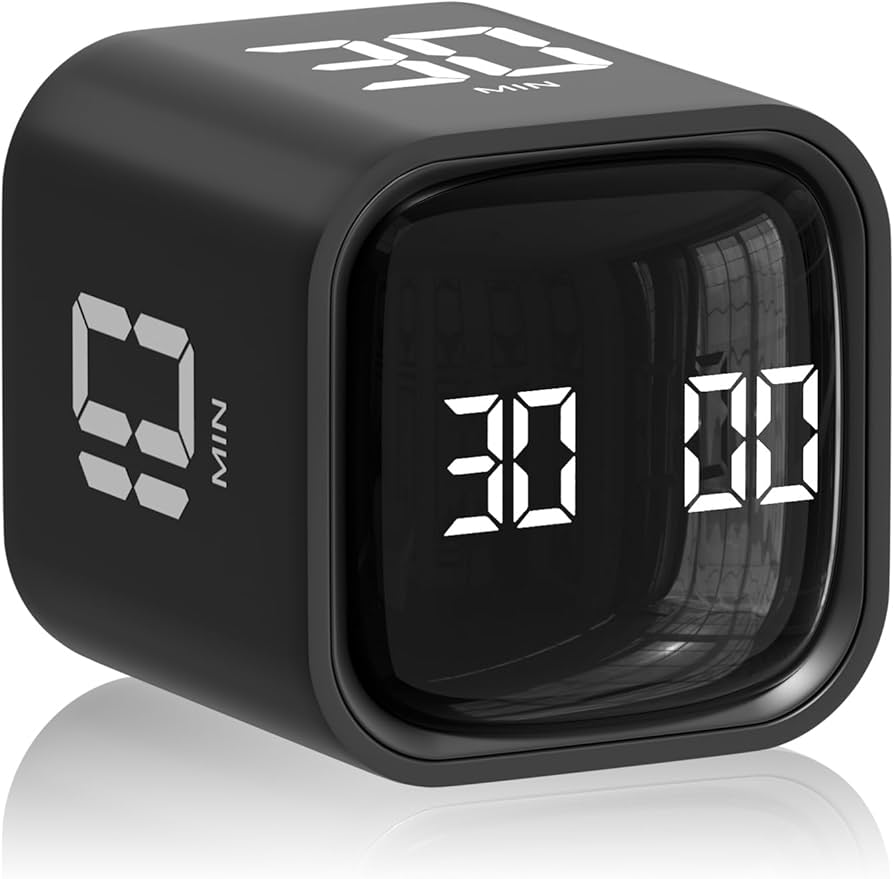
Which is also why I love the Pomodoro Cube Timer specifically over just using your phone. It's physical, it's simple, and—most importantly—it keeps your phone in your pocket. All you do to turn the timer on is flip a face to start it. There are no menus, no distractions, and no notifications sitting there waiting to pull you out of the moment.
2. A Physical Practice Journal
This is the tool most musicians skip, and it might be the most valuable one on this list.
When I say a physical practice journal, I mean just that. Not a notes app, not a Google doc, not a laptop. A physical journal—the kind you write in with an old-fashioned pen or pencil.
Here's why it matters: Loss of continuity
Without a record of your sessions, your practice has no memory. You work on something, make progress, walk away, and three days later you're not quite sure what you were doing or where you left off. That loss of continuity is one of the biggest hidden momentum killers in a musician's development.
A practice journal turns scattered sessions into a feedback loop. Before you start your practice session, write down what you're going to work on and why. When you finish, write down what you accomplished and what you still need to work on tomorrow. Over time, you start to see patterns: the things you keep avoiding, the areas where you're making real progress, and the concepts that keep coming up.
3. A Metronome (But Not the Way You're Using It)
Almost every musician owns a metronome. And almost every musician uses it the same way: as a safety net to keep from rushing.
That's not wrong, but it's also overlooking the most powerful use.
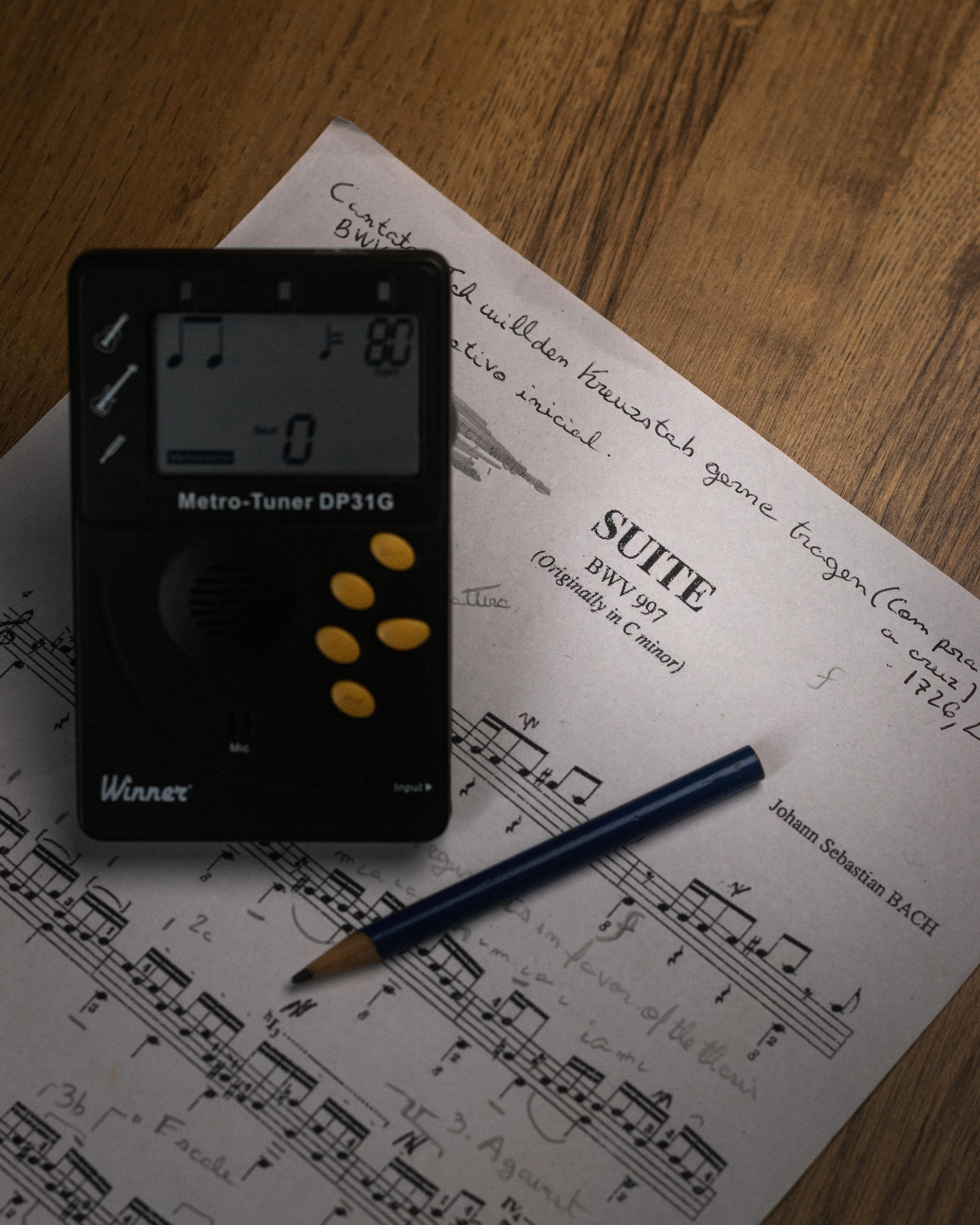
A metronome is most valuable when it reveals something uncomfortable — when it shows you exactly where your time feel breaks down, where you slow down in the difficult passage, or where you unconsciously rush in the transitions.
A few ways to get more out of your metronome:
Practice at an uncomfortably slow tempo
When you're playing something at full speed, there's a lot happening at once: your hands, the rhythm, coordination, and details such as articulation or phrasing. Slowing down isn't just about making it easier, but giving yourself enough time to actually pay attention to all of those things at once. When you slow something down, you allow yourself to notice everything that’s going on.
Practice short sections at full tempo
Things feel different at full speed than they do when you're playing slowly, both mentally and physically. Rather than jumping straight into playing an entire piece at full tempo, try taking just one hand, or just one small section, and playing it the way you actually hear it in a recording. That glimpse of what full tempo feels like helps you practice the right things slowly at first, giving you something concrete to work towards.
Turn the metronome off
After practicing with the metronome, play the same passage without it and listen carefully. Can you maintain your own sense of pulse? If not, the internalization work isn't done yet.
I know it's tempting to just use a metronome to stay in time, and then move on. But if you're only ever playing with the metronome as a safety net, you're not really developing your own internal pulse—you're just borrowing the metronome's. And that only gets you so far. The metronome, when you allow it, can act not only as a timekeeper but also as a conveyor of truth that you can refer to when needing to measure your practice against something. (I recommend this one.)
4. A Simple Recording Device
While a metronome is a great reference point, you need to develop your own sense of listening when you practice. And, using a recording device is a great way to do that. After all, hearing yourself back is one of the most uncomfortable (but necessary) parts of developing as a musician.
I can't tell you how many times I've been in a lesson with a student where they have sent me a recording of their playing and sent it to me for feedback. So we listen to the recording together, and what happens almost every time is when I ask them “So what do you think after hearing that?” They start pointing out the same exact things I would have told them.
When you're playing, you're focused on what comes next. You're not really listening to what you just played, so a lot gets past you in the moment. What often happens is you hear what you intended to play, not always what actually came out. Usually, things that become pretty obvious the second you hear them back. A recording doesn't do you that favor, though. It just plays back exactly what happened.
The simplest version of this tool is already in your pocket. Open your phone's voice memo app, hit record, and play. When you're done, listen back before you move on. Then, you can ask yourself:
Where am I rushing?
Where are the notes actually clean?
Where am I playing it safe and avoiding the riskier musical choices?
Most musicians resist this because it's uncomfortable. Your playing rarely sounds the way you think it does in the moment, but that discomfort is exactly where the growth is.
You can't fix what you can't hear.
5. A Backing Track App (or Drum Loop App)
This suggestion is more optional, but it still holds real value. While a metronome is a great reference point for rhythm, it doesn’t always help you at all with the style, and it doesn’t do anything with harmony. This is where drum loops and backing tracks might come in handy.
Drum loops are a great upgrade to a metronome
When you’re playing live, you’re not playing with a metronome. You’re playing with a drummer. Drum loops will help you become more comfortable with a specific style of playing versus relying on a metronome alone. I recommend Drum Genius because it has actual loops of real drummers that you can play along with, and it’s inexpensive.
Backing tracks
Backing tracks take drum loops one step further by having you practice with an entire rhythm section. Not only are you practicing the style and your rhythm but also staying together with the band. Backing tracks also prepare you to play with real musicians. Jumping straight into jam sessions can feel like being thrown in the deep end, and backing tracks can help ease you into it.
Some recommended backing track resources include:
Jamey Aebersold books and CDs
iReal Pro and other backing track apps
YouTube videos
6. A Quality Pair of Headphones
This one might seem more about comfort than practice, but good sound genuinely changes how you engage with the instrument.
Transcribing is how you actually learn to improvise
Transcribing is one of the most essential parts of developing as an improviser. It's how you internalize phrasing, rhythm, and harmonic choices in a way that no theory book can teach you. And to do it well, you need to actually hear everything.
Practice without an audience
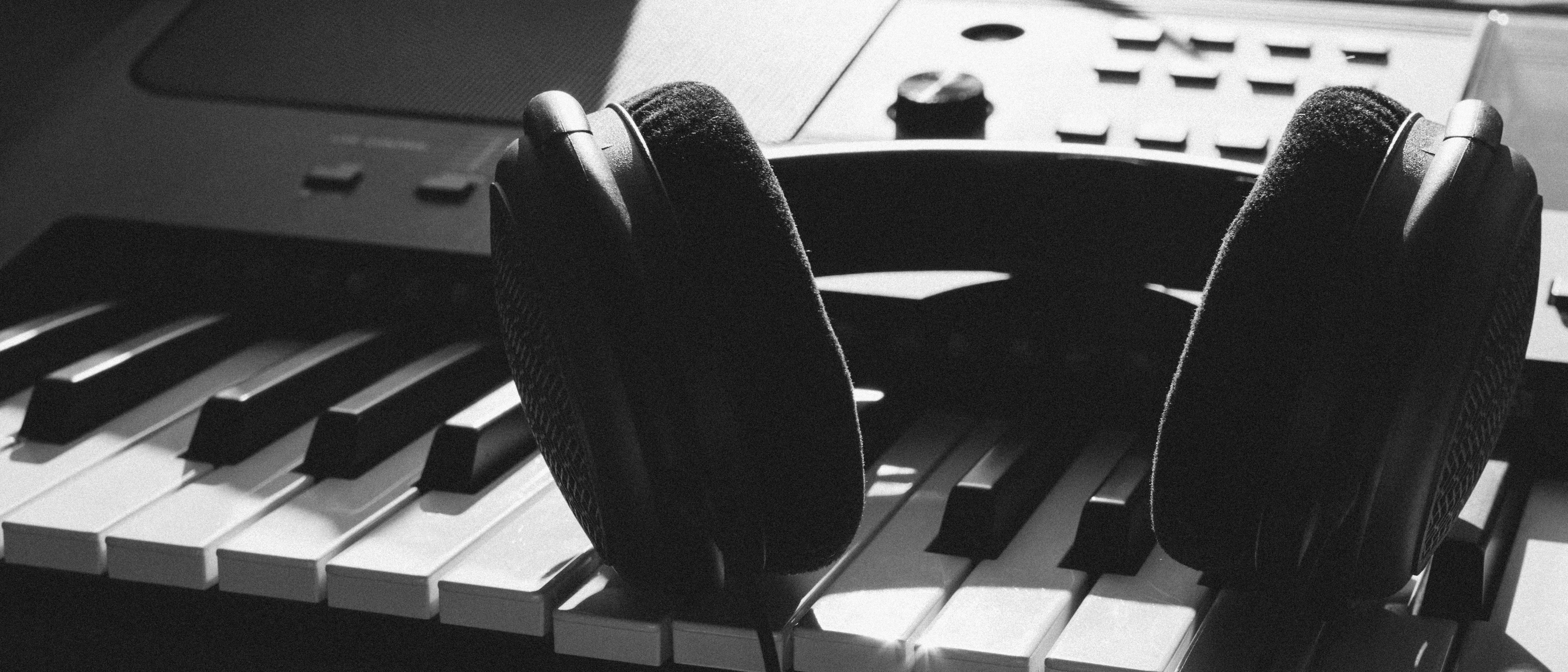
If you live in a house with other people or you’re self-conscious about your playing, headphones can give you the freedom to experiment, make mistakes, and play more freely. Plus, if you’re starting to practice with backing tracks, good headphones make it more of an immersive experience.
Some recommended headphones are Sony MDR-7506s or AirPod Pros.
The most important thing is just that you're listening on something that lets you actually hear the details, rather than having them muddied by low-quality speakers or earbuds.
Good sound makes you want to practice more. That alone is worth it.
The Tool That Makes All the Others Work
None of these tools do the work for you.
A cube timer sitting next to your piano doesn't improve your playing, just like a practice journal left blank on your desk doesn't build your awareness. And backing tracks playing in the background while you mentally check out are just background music.
What makes any of these tools actually work is the intention you bring to each session.
Before you sit down, ask yourself one question: what specific thing am I trying to solve right now?
The more specific you can get, the better. Not "get better at jazz" or "work on my technique,” but something concrete enough that you'll know at the end of the session whether you made progress on it. There's a big difference between sitting down to “work on jazz” and sitting down to nail the chord changes in the first eight bars of Autumn Leaves. One of those has a finish line, and the other one doesn't.
That's really what all of this comes down to. Not the tools themselves, but what happens when you use them with a clear purpose.
You start to actually hear yourself improving. Sessions stop feeling like something you have to get through and start feeling like something you want to come back to. That's when the real progress happens. The tools just help you stay honest.
If you're ready to take that kind of structure into your jazz piano learning specifically, I'd love to help. Check out the free guide below—it's a great place to start.
→ Download Anyone Can Play Jazz Chords — Free: A step-by-step guide to getting your first jazz chords under your fingers without the theory overwhelm.
→ Explore The Jazz Piano Launchpad: A structured, step-by-step course for pianists who want to go from feeling stuck to confidently improvising and playing jazz standards.
→ Follow along on Instagram: @michaelclementmusic